




Swan Lake Park is one of the most biodiverse areas in Markham, but it is under stress from the increasing urbanization of the area. The challenge is to preserve the biodiversity while accommodating the increase in visitors to the park.
Swan Lake Park is classified as a “Community Park” a category usually associated with parks with swimming pools and sports fields, not a naturalized park.
Swan Lake is a former gravel quarry, with poor water quality and deteriorating aquatic habitat. Swan Lake has been described as a “constructed wetland” and as a “closed system” because there are no surface level inflows or outflows.
Three Stage Program for Sustainable Restoration
FOSLP efforts are focused on a three-stage program: 1) Reparations 2) Rehabilitation, and 3) Stewardship
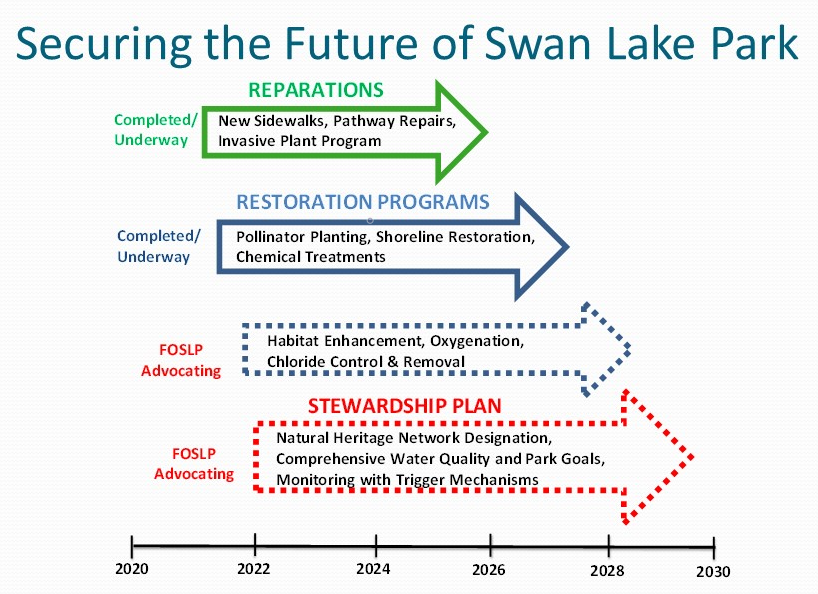
Reparation Programs Initiated by Markham
Fortunately, Markham has responded well and immediately to FOSLP’s request that they address several issues related to accessibility for those with walking mobility challenges by repairing park pathways and adding new sidewalks around the traffic circle on Swan Lake Boulevard.
Markham staff also moved quickly to address some of the invasive plant species identified by some of FOSLP’s volunteers and initiated the planting of pollinator flowers near the windmill.
In 2022, the tall invasive reeds, called phragmites, were removed from the eastern shoreline and some existing viewing areas improved.
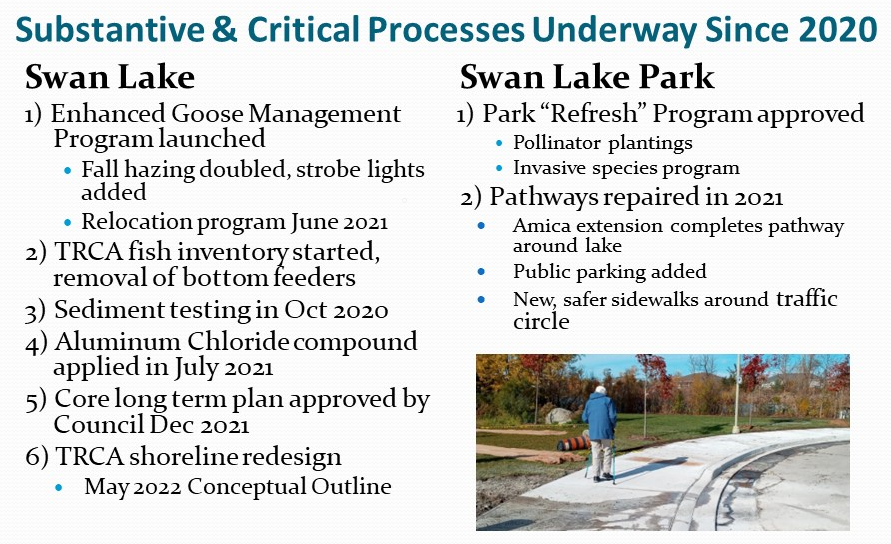
Read About the Park Refresh Program
Reparations to Swan Lake Shoreline
One of the major changes proposed by the TRCA in 2022 was a recommendation that the shoreline area include 4-5 recreational nodes for improved access for park visitors. In 2024 FOSLP recommend a lower cost option involving fewer recreational nodes and a new viewing area on the western shoreline.
FOSLP undertook a community survey in 2024, asking area residents their views on the need for investment in the shoreline. Responses from 124 area residents indicated:
- 80% supported FOSLP’s recommendations for a new viewing area on the western shoreline
- 69% of the respondents supported FOSLP’s lower cost recommendations for two additional recreational nodes while another 19% preferred TRCA’s more expensive recommendation
- Only 16% felt no new recreational nodes were needed.
FOSLP’s proposal was rejected by Markham staff, citing “equity with other parks”. However, there are only two other parks with major water bodies. This discussion triggered FOSLP’s request that the city review the park’s classification under the city’s park classification system. The review was approved by the Markham Subcommittee in June 2025.
See the results of FOSLP’s 2024 Questionnaire on Shoreline Enhancements
Rehabilitation Program for Swan Lake
In December 2021, Markham Council approved the Swan Lake Long-term Water Quality Plan which describes a phased adaptive approach with the initial five year phase from 2021-2025 and with a planned review in 2026 of the initial phase.
In May 2023, FOSLP submitted a report outlining additional lake management options for Markham’s consideration.
Markham has hired AECOM to undertake the Phase 1 review and to advise on actions for the next phase and have adopted a process that supports input from community groups such as FOSLP and from environmental experts. Markham staff have agreed to host a workshop or some other interactive forum to discuss submissions from various parties. AECOM’s draft recommendations will be shared with the workshop participants for commentary prior to the revised plan being submitted to Markham Council for consideration in 2026.
Read More About:
FOSLP’s Summary of Phase 1 Discussions
FOSLP’s 2023 Report on Lake Management Options
Markham’s Long-term Water Quality Plan
Rehabilitation Program for Swan Lake Park
FOSLP continues to press Markham to improve the habitat within the park area and to install a new viewing deck area on the Williamson Street side of the lake.
The biodiversity of Swan Lake Park is built upon the interrelationship between the terrestrial and aquatic habitat. A robust environmental policy framework should reflect the interconnectivity between terrestrial, aquatic and human elements.
In June 2025, FOSLP submitted its Preserving the Biodiversity report to Markham in support of its request for Natural Heritage status for Swan Lake and Swan Lake Park. The report details the birds, aquatic life, wildlife and terrestrial species in Swan Lake and Swan Lake Park.
In June 2025, 313 area residents responded to a Friends of Swan Lake Park’s (“FOSLP”) questionnaire about their views on the status of Swan Lake Park. They were asked about their concerns, if any, on the impact of increased urbanization on the biodiversity of Swan Lake Park. The community response to FOSLP’s questionnaire:
- 93% indicated they are concerned about the loss of birds and biodiversity
- 95% believe Markham should be doing more to preserve the bird and wildlife habitat
FOSLP’s Recommended Actions to Support Biodiversity Throughout Markham
- Develop an integrated Natural Asset strategy that reflects the interconnected terrestrial, water and human elements
- Develop an expanded Citizen Engagement model for use throughout the city by:
- leveraging the activities of the Swan Lake Citizen Science Lab
- endorsing Swan Lake Park as a pilot project for an invasive species management program comparable to the Toronto Nature Stewards’ program
- Adopt action plans to preserve bird populations outlined in the State of the Birds report
- Undertake to have Markham recognized as the next “Bird Friendly” city
FOSLP’s Recommended Actions for Swan Lake and Swan Lake Park
- Designate Swan Lake and Swan Lake Park as Natural Heritage Assets
- Extend the naturalized areas in Swan Lake Park
- Develop a nesting support program for the wildlife within the park
- Engage environmental consultants to develop recommendations for a program to stabilize and enhance the habitat for all wildlife species.
- Accelerate the aquatic habitat program during the next phase of the water quality program
- Support human interaction in the park by approving shoreline enhancements such as recreational nodes and other features such as Forest Therapy trails.
The environmental policies adopted by Markham in May 2024 provide an important structure for managing the land-based assets but do not provide a policy framework for the water elements within Markham.
In 2020, the City of Brampton initiated two programs that provide an integrated environmental focus for their parks and lakes. Many of Brampton’s 14 lakes fall under the TRCA’s jurisdiction, but Brampton still recognized their role in managing these critical assets, particularly the human interaction element. Brampton’s approach is referred to as “holistic” – assessing the whole. Their Eco Park and Lake Enhancement Strategies are designed to bring together all elements to achieve integrated community and environmental objectives for their parks and 14 lakes.
FOSLP has recommended that Markham look to Brampton’s approach for an integrated management plan for its natural assets.
Read More About:
FOSLP’s 2025 Report on Preserving the Biodiversity
Brampton’s Eco Policy
Brampton’s Lake Enhancement Strategy
Markham’s Policy on Management of Natural Assets
Stewardship
Swan Lake and Swan Lake Park are unique structures and are not properly aligned within Markham’s policy framework
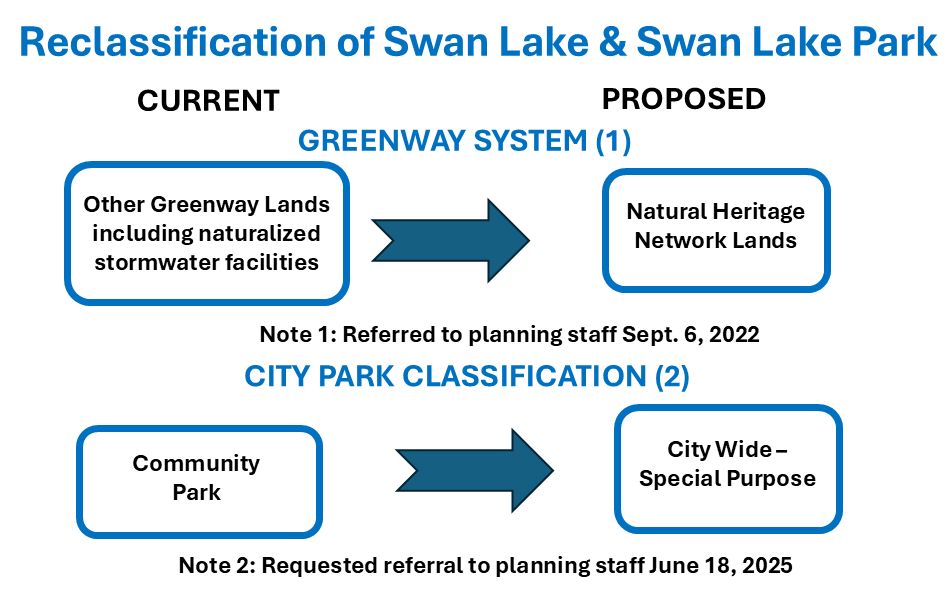
In Markham’s 2014 Official Plan there are two classification systems that impact Swan Lake Park. Swan Lake Park is classified:
1) as “Other Greenway lands including naturalized stormwater facilities” under Markham’s Greenway System. FOSLP requested that the lake and park be designated as Natural Heritage Lands, the designation assigned to Milne Dam Conservation Park and Toogood Pond Park.
2) as a Community Park under Markham’s parks policy. FOSLP requested the park be reclassified as a “City-wide – Special Purpose Park” to recognize and preserve the biodiversity of the park.
Swan Lake Park is much more than and very different from any other Community Parks. Swan Lake Park is one of the most biodiverse areas in Markham and serves a role beyond that of a typical Community Park. It requires investment and support related to its critical and unique function as a natural asset within Markham.
In 2020, Markham staff acknowledged that Swan Lake was a regulatory orphan. It is not considered part of the Rouge River watershed nor a stormwater pond, so it has been managed as a unique feature without any formal environmental standard.
In June 2025, FOSLP undertook a survey of area residents asking their views on the status of the park with a total of 313 responses.
In terms of the environmental status of the park:
- 93% indicate concern about the loss of the biodiversity of the park
- 95% felt Markham should be doing more to preserve the biodiversity
- 86% supported expansion of the naturalized areas of the park
- 88% supported classifying Swan Lake Park as Natural Heritage Lands.
In terms of the city-park classification of the park:
- 81% would support a waterfall in the park.
- 78% would support a Forest Therapy area in the park
- 72% were concerned about increased urbanization on the park
- 71% were concerned about the impact of increased visitors on the wildlife
- Only 54% would support classifying the park as a Destination Park.
- Only 45% would support using some of the park for increased parking.
In June 2025, the Markham Subcommittee approved FOSLP’s request that Markham’s 2025 Official City Plan review include a review of the classification of both Swan Lake and Swan Lake Park.
The staff recommendations on reclassifying the lake and park are expected to be released in 2026 or 2027.